Michigan is off to one of the most impressive starts that college basketball has seen in years. The Wolverines are 13-0, but how they’ve won games is even more remarkable. At +39.43 net rating on KenPom, the gap between Michigan and No. 2 Arizona is 4.93 — or almost as large as the gap between Arizona and No. 8 Illinois.
The Wolverines started slowly with narrow wins over Wake Forest and TCU, but reached sprinting speed in Las Vegas and haven’t slowed down. They won three games in three days by a total of 110 points in Las Vegas, and haven’t played a game closer than 18 points since.
Here’s a deep dive into Michigan’s success, why it works, and whether it will keep on working.
Pace and passing
The best description of Michigan’s dominance comes from Dusty May himself, on his first day as Michigan’s head coach. The vision he outlined for Michigan basketball is precisely what he’s built in year two.
“If we ever walk the ball up the floor, if we’re not at least jogging or moving at a solid pace, then the guys will hear from me. It needs to be free-flowing. They don’t want the defense to ever get set. We shoot probably too many 3s. We finish at the rim, we play modern basketball.
“…Fast-paced, energetic guys that want to share the ball, playing together, all five guys are connected on both sides of the ball. It’s more like jazz, we’re playing off of each other, reading each other.”
It should come as no surprise that two of the things that make this Michigan team special are pace and passing. The Wolverines play as fast as any team in the country, and they share the ball as well as any team.
The pace is obvious, the style is a bit more subtle. May pitched a style of play similar to jazz, and that’s what Michigan has created. Everyone plays a part, cuts, passes, and shoots.
Six of Michigan’s nine rotation players have an assist rate over 10%. Three starters are arguably among the best passers in the Big Ten for their position.
The beauty of the pace, passing, and balance is that there are rarely set plays or designated action. It’s a team that knows how to play offense, plays off its teammates, and plays in flow, asking players to read and react to the game rather than execute specific actions.
Michigan’s roster, from top to bottom, knows how to create offensive advantages or play off the advantages their teammates create. They process the game so quickly that every possession blurs the line between transition and half-court basketball.
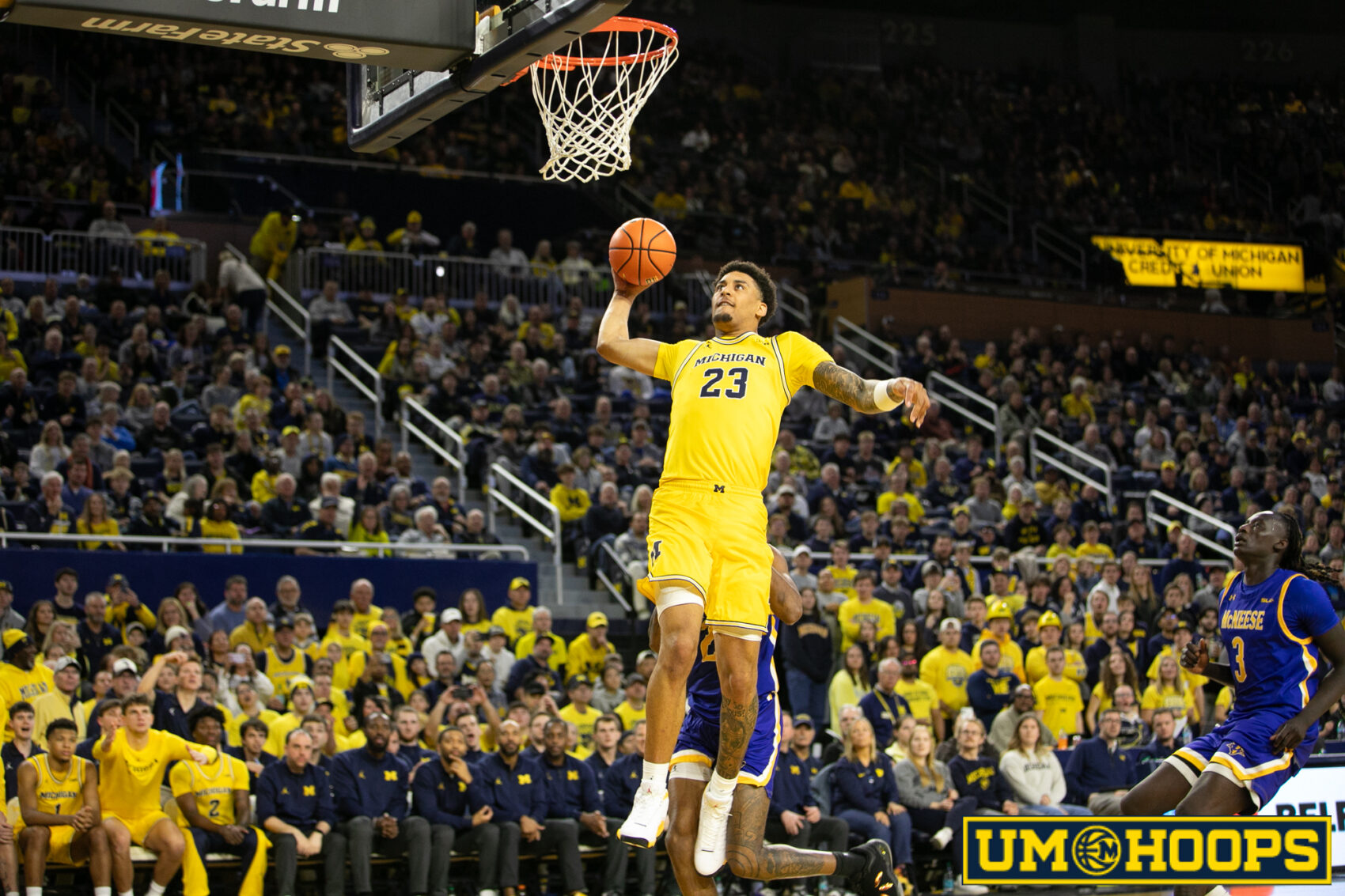
Michigan’s transition offense is humming at a level that the Big Ten has never seen. The average Michigan offensive possession is just 14.4 seconds long — fifth fastest in Division I — and it is ranked 4th nationally in tempo at 75.3 possessions per game. Since KenPom’s stats began (1997), no Big Ten team has ever finished in the top ten nationally in adjusted tempo.
The Wolverines are scoring 25.7 transition points per game, 7.8 more than No. 2 Michigan State.
Synergy’s logging data dates back to 2005-06. In that timespan, one Big Ten team has scored more than 20 transition points per game (Fran McCaffery’s Iowa in 2023-24).
Join the UM Hoops Community
Join the only community dedicated to Michigan basketball
Get ad-free articles, recruiting, advanced stats, member-only discussion, and the most complete Michigan hoops analysis anywhere.
Already a member? Log In