
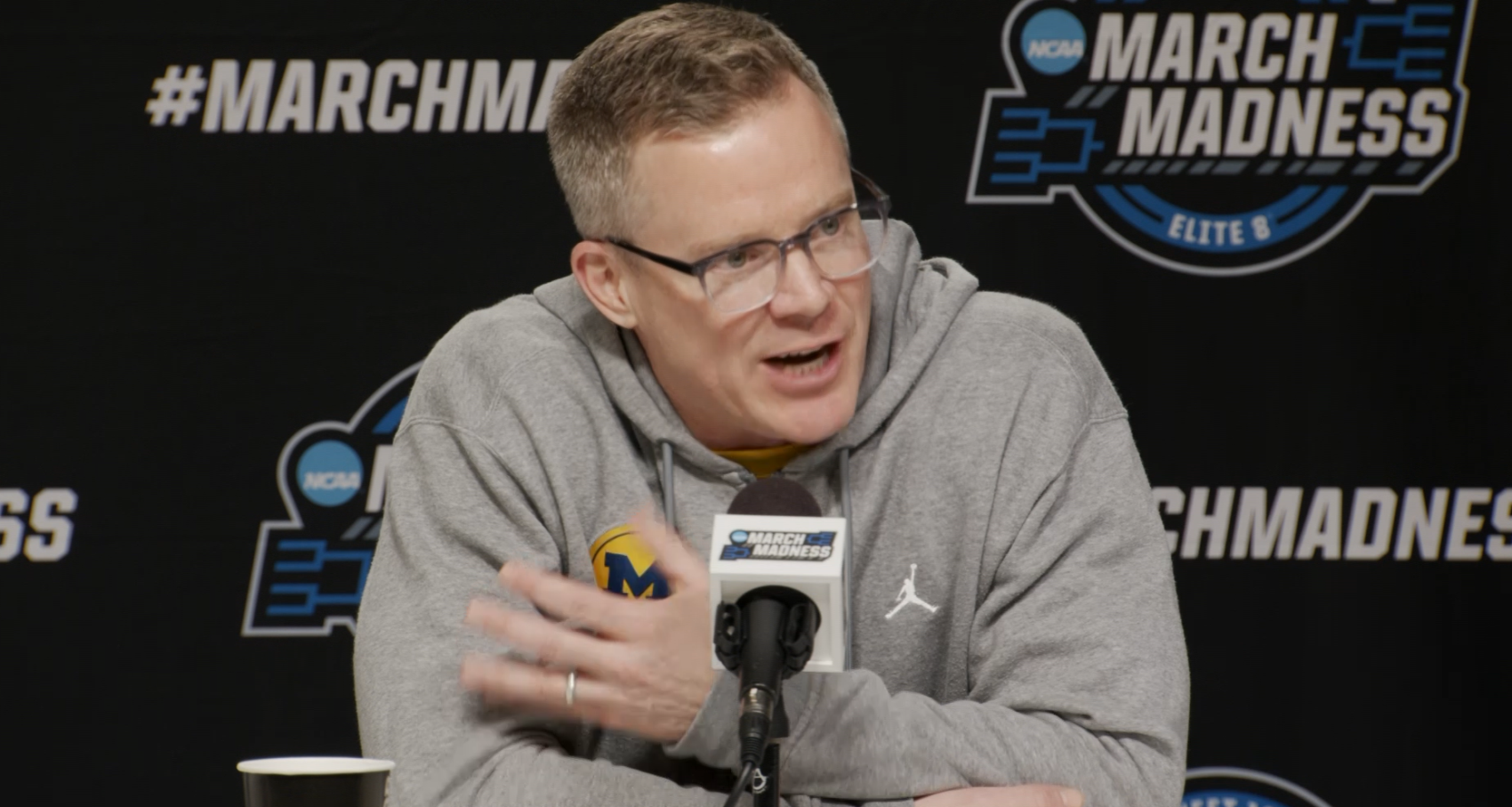
Dusty May, Roddy Gayle Jr., Yaxel Lendeborg and Trey McKenney were on the podium to preview Alabama.
Q. Roddy, I think you said early on that when Trey first got here, he wasn’t talking much and you weren’t even sure that he liked you. Does he like you now, and can you talk about how he has developed as a person and as a player since he’s gotten here?
RODDY GAYLE JR.: I think he likes me. Me and my relationship with Trey has definitely progressed over the year. He’s become one heck of a player, especially with his maturity level throughout the year, and his ability to adapt in any situation, especially defensively, and being more of a play maker.
Q. This topic is still staying with Trey. Since L.J. got injured, you’ve had a combo job role and you’ve really extended your skill set. When you self-evaluate how you’ve performed the last six games, can you gauge where Trey McKenney is in his game?
TREY McKENNEY: I think I’ve gotten a lot more comfortable with playing point guard. Coach Dusty has done a good job making sure I’m comfortable with the players and different concepts to get in during the game when I’m in that position. Give a lot of credit to him and the staff, they gave me the opportunity, and I think I’m at a point where I’m very comfortable doing it.
Q. The last time you were here, things obviously had a rough ending. I’m wondering how much that’s lingering on your mind, and how does it feel to be back here so soon?
YAXEL LENDEBORG: Yeah, definitely left a bad taste in our mouth. As soon as we walked in the locker room — they gave us the same one as last time, so we had to try to switch something up, see if it’ll give us a little more luck. We want to make sure this time we don’t leave with any losses. We’re going to handle business. So we’re going to come in with a better mindset and do the best we can to dominate.
Q. Yaxel, how did you switch it up? Did you take different lockers, put your bags in different directions, places?
YAXEL LENDEBORG: Yeah, we switched it up. We tried to switch the whole vibe in the locker room in general. Everybody is sitting in different places, acting differently. We’re just trying to change everything completely.
Q. Trey, as a freshman, your first taste of the NCAA Tournament. You’ve obviously played in big venues, arenas, all that stuff, tough places. How is it different for you encountering this for the first time, the crowd, the craziness? How different is it and how has your adjustment been to that higher stage?
TREY McKENNEY: Obviously the stakes are way higher at this level and I’m playing with a really talented team. It’s not like anyone on the team really has to do too much out of their role. Just being here with these guys, I’ve built a really good relationship with these guys throughout the season. It’s much more than basketball when you’re playing with them.
Q. When you guys look at the six Big Ten teams left in the Sweet 16, how prepared do you feel for this moment right now, having played in a conference that has so many teams remaining?
RODDY GAYLE JR.: Yeah, I mean, it’s very important, especially I feel like we went through a gauntlet of a schedule this year. Playing against these guys throughout the course of the year, we beat up on each other, and I think that makes us better.
I think the Big Ten conference is the best conference in the world. So just seeing the success — obviously we want everybody in the Big Ten to be successful. But just kind of seeing the success that the conference has had in the tournament is really good. And I think it speaks to how good we were in the season to be able to finish first.
Q. Yaxel, you had sort of an unusual path to Michigan based on how little organized basketball you played growing up. Now that you’re with a coach who is a total film junkie and rather a savant of the game, what are some of the biggest areas that he encouraged you to work on when you initially came to Michigan, and if you’d reflect on the biggest areas of growth that you’ve had?
YAXEL LENDEBORG: I would say my approach toward the game of basketball has gotten a lot better. Just being able to slow the game down, as well. He’s been telling me and teaching me a lot of reads that I didn’t think were there. Early on in the year, we would watch film and he’ll just help me fix my reads, fix ways where I can be more impactful, even in a role where I’m not being as aggressive as a scorer anymore. It definitely helped me out a lot. It helped me mature more in the game of basketball.
Honestly, I’m really grateful I was coached by him. And, man, he’s just given me a lot more to play for, like more will to just go out there and try to be the best I can be regardless of how it’s going. He’s definitely helped me work on my mental. When things are going bad, I lean more on my teammates instead of beating myself up so much now.
Q. For Roddy and Yaxel both, how would you describe what Dusty May’s system on the basketball court looks like to someone who’s never seen it? How would you describe what it means to be playing for him?
RODDY GAYLE JR.: I mean, it’s pretty simple. He’s very positionless. I think the kind of things we run and the kind of way we play is super free. It translates to the next level as best as you can possibly do it. Just his ability to create and find different things and just make something out of nothing.
Honestly, whenever we mess up plays, he likes it. He’d rather our offense be chaotic. But we also are trying to play for each other as far as not really trying to play selfish basketball or kind of by ourselves. He’d rather us play for each other and run actions for each other.
YAXEL LENDEBORG: On top of that, I would probably say he has a pro type of style. He does a lot of free-flow offense. He has certain sets, but the sets aren’t necessarily for shots. It’s just for movement, just to get the defense out of their shell, and then attack off those mistakes. It’s a pretty free-flowing offense.
Q. Yaxel, Dusty seems to have a connection with almost every coach you guys face. Really close with Schertz, history with Nate Oats. How much intel or insight do you think he gave you in the film study? Did it seem familiar or do you feel like he gave you a lot more insight on what their game plan might be?
YAXEL LENDEBORG: Honestly, I would say it was pretty much the same way we attacked the film session with Saint Louis. Because of all the similarities in our game, it’s pretty much like an easy cover. We’ve just got to be physical. We’ve got to be physical, we’ve got to play — we’ve got to do things that we don’t like that teams do to us to them pretty much. That’s what we’re learning and trying to imply.
Q. Yax, you were at UAB for a couple years. How did that time prepare you for this moment? I know you’ve been really complimentary of Dusty once you got to Michigan. Then also as a former UAB Blazer, do you feel anything differently playing against Alabama?
YAXEL LENDEBORG: Yeah, once I entered the transfer portal out of UAB, I was hoping to get recruited by Alabama. And when I didn’t, it kind of hurt me a little bit. Not in a way with I can say I hate them and all that. It’s just it bothered me a little bit.
But I was very proud of the moments that I had in Birmingham. I definitely learned to be more aggressive, get out of my shell a lot more. And in situations where I feel like I need to step up in a way, I’m not afraid of those moments anymore. And that definitely happened because of how much pressure Coach Kennedy put on me and how much he wanted me to be an aggressive scorer.
Those two things really helped me out. But I’m super excited for Alabama and just pretty much like a second home, I guess you could say.
Q. There’s something behind the smile, obviously, but how much extra juice is this going to have where obviously you were dissed by Alabama in the recruiting process?
YAXEL LENDEBORG: There’s going to be a lot of extra juice for sure. I know I’m going to try my best to be the best player on the floor tomorrow. All it is is extra motivation, just not in the sense where I’m like, this is what you guys missed out on, but like, you guys could have at least called or something like that. Something like that.
But yeah, there’s no bad blood. Maybe I didn’t fit the system or anything like that. But I’m excited to see him.
DUSTY MAY: We’re excited to be back in Chicago with a chance to compete and continue on with our season. It’s an honor to compete against a program like Alabama and with the other two teams here.
Q. We don’t have a lot of transparency into how much it really costs to put a team like the one you have together. At a school like Michigan — and Alabama faces the same thing where football has to eat as well — how do you do it year after year, and is it sustainable at the rate it’s going?
DUSTY MAY: It’s a great question. I mean, you hear year in and year out that this isn’t sustainable and all reports point towards the numbers going up. I think when you see the ratings and when you see all that’s happening around our sport — I can only speak for men’s basketball — it seems as though there’s an influx of everything, of money, of attention, of new avenues to generate revenue.
I can’t see the cat going back in the bag, personally. Fortunately we’re at a brand where — each school is in a different situation based on their alumni base, based on how marketable their athletes are, and the attention and spotlight on their program. So fortunately we have a lot of those things working in our advantage.
They didn’t just happen. It’s almost like, as they say at FAU, when these businesses or donors believe in a CEO, in a vision, in a leadership team, then they’ll invest until it doesn’t go well, and then it’s time for a new CEO and a new staff to come in. We’re not naïve to that. We have been very diligent from day one to make sure that anything we spent we thought would be spent wisely and anyone we brought in would be very useful.
Q. I want to ask a little bit more about one of those guys that you brought in that way, Aday Mara. Earlier this week Mick Cronin said you have to detach yourself from college basketball, what it used to be, I spent two years developing and now you’re going to leave. That’s going to happen to you, it happened with Aday Mara; it’s a business. Your thoughts on his development, him seeing you as a developmental program or how that played out?
DUSTY MAY: Yeah, I want to credit every past coach for everyone on our roster, every teacher. They all have a hand in these guys’ development.
I will say that success has many fathers, and failure is an orphan. We’re very proud of the progress Aday continues to make, and like I said, I’d like to thank all of their past coaches for the work they’ve done up to this point. It takes a village and a team effort to help these guys be their best.
But we choose to give our players a majority of the credit for their development. We think we do a good job of helping them, guiding them, and assisting them. But usually if a guy gets better, we try to give him 90 to 95 percent of that, and we’ll take a little bit of that percentage just because that’s what we get paid to do.
Q. Dusty, you chose Michigan over some blue blood programs. What is it about Michigan that’s on par or in your opinion higher even than some of these other programs?
DUSTY MAY: Well, first and foremost, my wife. She was always a big fan of Ann Arbor, the quality of life, everything that goes with the University of Michigan. And my family has always been a very important part of any decision that I’ve made, especially when you drag them around like I did chasing this dream.
That’s another reason why I don’t get mad at these low major guys trying to move up to the mid major, because I was trying to do the same thing, and pride myself on not being hypocritical. But the opportunity to attract the best, the high achieving people that have a desire to be around the brightest students, the best professors, the alumni base who’s connected.
And I think Michigan is really unique. I’ll tell you what we say in recruiting, that we have what we feel is the academic profile of Stanford with the passion of SEC football for our athletic department as a whole, and usually those two things aren’t merged.
So we’re very proud that those two things are in great alignment at Michigan.
Q. Dusty, I remember vividly when you came back from Vegas, the big three wins in the tournament. I asked you despite your team playing really well, what keeps you awake at night, and you said, outside noise will keep me awake at night. How is the outside noise maintenance going right now on the brink of the Sweet 16, potentially Elite Eight, and are the players involved in laundering that outside noise?
DUSTY MAY: I think our guys do a very good job of deciphering what’s important and what’s not. These guys I would say 99 per of them are on social media, they hear things. A couple of them asked me about a kid who was allegedly committed to us on Twitter from a fake account.
That just goes with it. If the kid was committed, we would tell them; if he’s not — we try to be brutally honest with our guys and never violate their trust and give them our vision. It’s never easy, but we’re all battling the same thing.
But I think overall we’re in a very good spot mentally. I think our guys are focused on this game and the preparation that we need to have to be in position to win.
Q. Dusty, Yaxel said that your team realized they were in the same locker room again. They wanted to change lockers, mix it up, and even act differently just to change the look from a couple of weeks ago. Did you know about this, and what kind of stock do you put in that part of these moments, just the psychology of that?
DUSTY MAY: I don’t put as much stock in this physical location as I do our mindset. I will say our trainer, Chris Williams, after one of the games in the Big Ten Tournament — I don’t remember if it was the game we got beat or the game to go into the championship — we were talking about the story I think it was Doc Rivers before their NBA championship with the Celtics.
They were in the — wherever the arena the year before, and everyone put $100 or $20 in a stack and put it in the ceiling tile and said, we’ll be back for this in June or whatever the month was. Chris was contemplating — I think he actually put something up there in the tiles, if I remember correctly.
But I’m not a very superstitious guy. Actually I’m not a very good dresser either as all of you know. I had a really nice — my favorite pair of Jordans that I rarely wear because I don’t want them to get scuffed. And I liked them and I wore them with suits. But I wore them for the Wisconsin game at home and we lost. And I broke them out for one of our recent games. I thought, you know what, I’m going to prove once again that all this stuff is nonsense, so I broke them out, and obviously we won with them.
Personally I don’t look at any of that stuff. I don’t have any superstitions. Literally zero superstitions. It’s get up and do the best you can that day.
Q. Yaxel just told us that he was disappointed that Alabama didn’t recruit him out of UAB. He said he might have some extra juice in this game. Is that a good thing? Or can players get a little bit too high, too motivated? How do you channel that if he’s going to have some extra juice?
DUSTY MAY: I think we’ve had several subplots this year and he seems to be performing well up to this point, so whatever irritates him, I’m going to ride with that and support him. Nate and I being friends, we talked through that process. And don’t tell Yax, but they did try to recruit him.
Q. I wanted to ask you a little bit about your philosophy of starting three very, very tall players. You kind of pushed it in a different direction last year with your twin towers, but what made you when you were building this team want to run that kind of offense and why do you think it’s been able to be so successful?
DUSTY MAY: Well, this wasn’t part of the original plan. The plan was to get two bigs to replace Danny and Vlad. And then Will Tschetter, Oscar Goodman, and Malick Kordel, and then we were able to get Aday and Morez right off the bat. I was perfectly content going into this year. I felt like we could compete to be at the level we’re on with that group without Yax. Maybe we could, maybe we couldn’t. We’ll never know.
Then Yax was going through that process. And we were open and honest with Aday and ‘Rez both that, hey, this could happen, we don’t know. Yax is going to go through the process, but we’re very confident that we can make it work, and here’s our plan and what it can look like. We thought this would be very difficult.
When they were all on campus this summer, there were several days where I thought to myself there’s a high probability this isn’t going to work. And then if you watched us play the first couple games of the regular season, I think you’d probably agree that it wasn’t working. And it wasn’t going the way it went in Vegas or the way it’s went lately.
I give our guys a lot of credit. They’ve done a nice job of solving problems and putting the puzzle pieces together the right way and really respecting each other, appreciating each other’s talents, and figuring out how they could be their best while also playing next to a guy that’s really big and talented. Because typically that’s a recipe for disaster from a spacing standpoint. So I’m very proud of our guys for finding these solutions.
Q. Coach Oats told us earlier that he called you early on in Yaxel’s transfer portal situation. What did you both talk about that sort of put him off from really going after him?
DUSTY MAY: Well, what did I tell him to put him off?
Q. He said that he felt he was late to the game and that’s why he didn’t pursue as much as other schools had. I’m curious what you both talked about.
DUSTY MAY: Yes. We were extremely late to the game, as well. When we actually made contact with Yaxel’s mentor after their season ended, he said Yaxel is actually upset with you because you haven’t called. I think it the NIT, second or third round, he said Yaxel is actually — and I had spoken with Andy Kennedy prior to that and their staff.
But he said Yaxel is actually disappointed in you that you haven’t made contact and no one with Michigan has made contact. And I said I’ve talked to AK. We’re not disrupting anyone’s season, no matter what rumors are out there. Usually we’d just call the head coach.
But then he asked me why we were in so deep, and I told him that the person that Yaxel trusts the most is a guy that I coached coincidentally 20-something years ago. And he felt like this would be a great environment and we could help Yaxel with what he needed to improve on. Yaxel went through the process and tried diligently to get a first-round guarantee and couldn’t get one. And then it made sense for him to come and try to improve and develop and be on this big stage.
Q. You obviously just faced Josh and now you’re facing Nate tomorrow. Would you say it’s more challenging going against a coach that you’re very familiar with?
DUSTY MAY: Both. It’s challenging because they’re elite ball coaches, but it’s more fun because you’re familiar. I go to Nate’s basketball conference. I’ve known him for 20 years. I’ve probably watched his teams play 500 games total. If they’re on TV and I’m not doing anything, I watch his teams play because I’m going to learn something.
We have mutual friends that send out these edits and clips and new ideas. So I watch something and say, oh, wow, they took that concept from Barcelona and really made it their own and they’re executing better than that team did. It’s a challenge, but I enjoy it because I know we’re going to be better coaches because of this.
I think he’s one of the best coaches on the planet regardless of league, level, affiliation. It’s an honor to share the same sideline with a guy that does his job as well as Nate does.
Q. Along those lines, is it a bit surreal going up against a guy who you saw all those years ago when he was in high school and now you’re meeting in the Sweet 16?
DUSTY MAY: Yeah, I think probably the thing now that you say that is surreal was when he was a high school coach and I was an assistant at Eastern Michigan. I was in his gym and I told him I was going to come over to watch the Bulls training camp. Skiles was the coach. Because a connection of mine was on the staff and got me access. And he said, can I go, and I’ll drive and whatever.
So we drove over and watched three, four, five days of the Chicago Bulls training camp, talked ball, spent every meal with Nate and Josh Baker who worked with Nate forever that’s now back in Michigan.
That’s probably a surreal moment as a young 26-year-old third assistant in the MAC and a local high school coach who are now back in the same city competing against each other on this stage is pretty surreal.
But that’s what makes this all so ironic. I don’t know how it happened.
Q. Dusty, I’m curious, when you look at NIL’s impact on college basketball, it’s been pretty well documented. But over the last year with rev share, how have you seen that impact everything, whether it’s from roster building or any other impact it has on the game?
DUSTY MAY: I just follow football, to be honest. When they announce these numbers, I thought, wow, is everyone going to be under this cap? And then football spends three times — I don’t spend a lot of time thinking about it. I have my own opinions on where the game needs to go and why we failed our sport for so long as coaches and administrators to let it get to this point.
But ultimately it’s our fault. We’ve been making these decisions on such an obtuse level for so long that now it’s blown up in our face. So now we have a responsibility to fix it and to make sure it’s equitable and fair for everyone.
So I don’t know. I don’t know. I’ve heard the numbers. I’ve heard from agents. It doesn’t seem as though the rev share number is any type of hard cap or soft cap.
Q. Coach Oats mentioned you guys talked last night. How hard was it not to talk about basketball this time of the year with you two being the basketball junkies you are?
DUSTY MAY: It’s not that difficult. We faced it last week with Coach Schertz. If we lose, I’m going to be watching and cheering for him because of our friendship and also the respect I have for what he’s done for our game. He is a basketball junkie, a lifelong learner. And we’ll talk 10 times this summer about ways we can do a drill better. We can share something that we’ve learned.
And ultimately that’s what it’s about, trying to be the best you can for your players, for the younger coaches, for the growth of our game.
But no, now when we speak, it’s about the other stuff. It’s not about basketball. We’re not trying to trick and con each other to gain an advantage.







ReegsShannon
The three amigos
kturnup
no question about UNC…
ReegsShannon
There was a question about why his job is better than “blue bloods”
telekinetic
the stars: they’re just like us!
umhoops
lol!
Notale quote from today: