
Dusty May
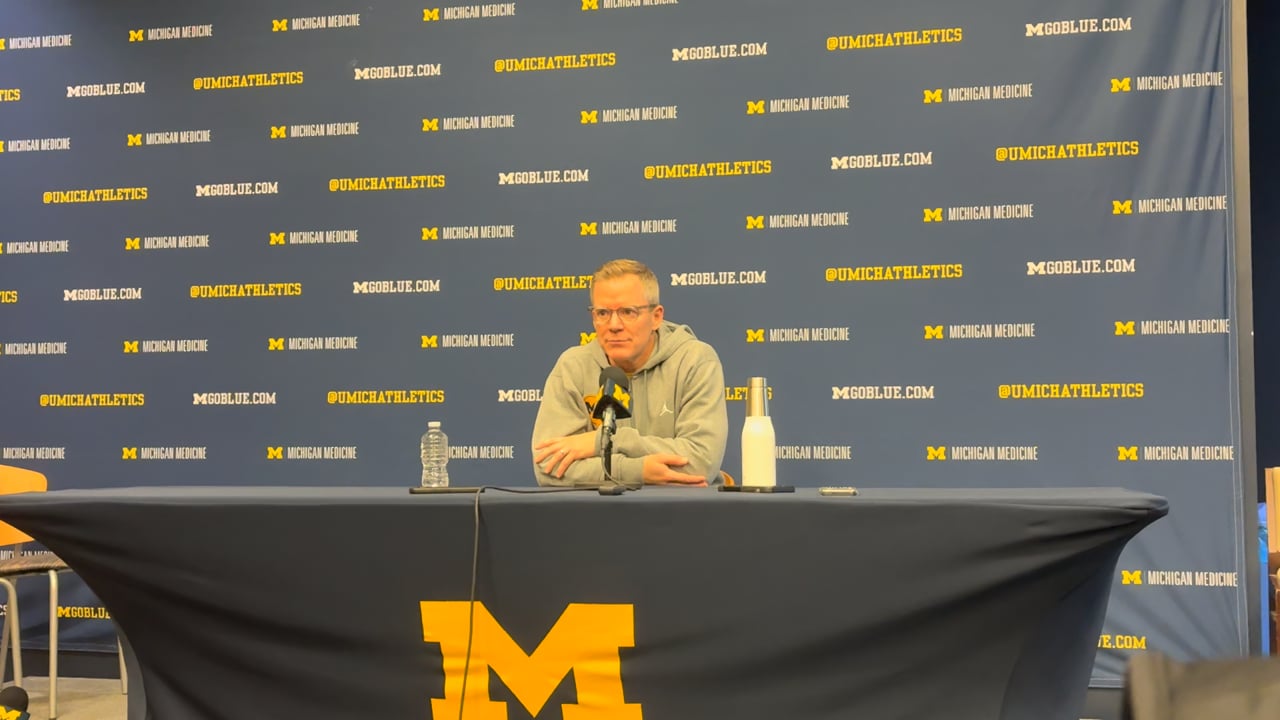
Key quotes
- “We threw a lot at the wall. I think that the things that really clicked are we're focused more on simply getting possession over position.”Q3 ↓
- “I thought L.J. Cason played maybe his best game as a Wolverine, and I don't know how many minutes he played, but it wasn't nearly enough.”Q11 ↓
- “But with that being said, no, we want him to take what the game gives him.”Q7 ↓
Transcript
Q3 Winning the turnover battle
And I know we ask you when you guys are turning the ball over a lot, but you guys have been winning the turnover battle in a lot of these games as of late. I guess is there something you— is there a fix you guys feel you found, or I just— what can you attest to improve?
We threw a lot at the wall. I think that the things that really clicked are we're focused more on simply getting possession over position. I think sometimes we throw throw a pass and if it wasn't going to lead to the layup, we would almost like try to catch it and score it instead of just getting, getting possession of the ball. And then even if we have to reset, that's fine.
Um, but no, I think it's more the guys are giving each other better spacing. And I told the staff, this is the first time that I felt like we're playing really fast, but we were playing slow. And I think that's a sign of a really, uh, competent, potent offensive team. And now it's obviously against a young Maryland backcourt and a front line that hadn't played a lot together after Payne's injury.
So it's all perspective, but I do think we're trying to generate offense together versus trying to make plays every time we touch it. Because if 5 guys are trying to make a play every time they touch it instead of generating advantages, then you're not going to look like a good offensive team. You're going to have to settle for hitting hard shots to beat teams.
And we don't really want to have to settle for making low-value shots to beat good teams. Charles.
Q7 Yaxel Lendeborg's 3-point shooting
You've talked about Yaxel Lendeborg's confidence and willingness to shoot the 3. 3 going up, and it looks very obvious now at this point. Is there ever a point where he's shooting too many?
I mean, because he's taking away from other stuff he does so well. I just wonder how that balances because he looks like he's shooting it really, really well.
They're worth, uh, 3 points, and so if he moves a step in, they're worth 2. Um, we want to take what the defense gives, and if they close out aggressively, take away his 3, we want him to drive and make the right play. If that means he shoots 27 times, you know, I think that These games start to run together, I'm sorry. But I think the Villanova game is an indicator of a very bright, intelligent team as well because they were playing us, they were face guarding 3 guys on the perimeter and playing our pick-and-roll 2 versus 2.
And I thought Elliot Cadeau got super aggressive. He took what the game gave him. And if I remember correctly, Yaxel Lendeborg only took 3 shots as a— you know, right now he's the runner-up in the Palm for National Player of the Year and he takes 3 shots in a game. Game when we were up 30 and a half.
I mean, I don't think there's a testament to a team's unselfish more than that across the entire globe of basketball. But with that being said, no, we want him to take what the game gives him. We're trying to add a few things to his game that he can use against certain matchups before he needs it. But no, he's such a gifted passer.
We felt like from day one he needed to shoot a lot. A lot more threes because it helps us and it helps his long-term value. And that's also, you know, we want these guys to max out as individuals after they're ready for any situation to max out as individuals. And if he's going to play at the highest, highest level and be— and still stay at the highest level, he needs to be able to shoot 3-pointers efficiently and effectively and make the right decisions.
Q11 Response in tight games
TCU, you know, good second half. Maryland battled back a little bit. What have you liked about those two games that kind of give you confidence knowing that there are some tough environments you'll be in going forward?
Well, first, they presented so many different challenges, and I think a roadmap of how to navigate those, those same types of offenses or defenses we're going to see. But most importantly, you know, I just think that a lot of times when you get into those tight, tight games, certain guys can elevate their play and then certain guys can play tighter or more conservative.
And what I've seen is a group that is unflappable, they're confident, they're unafraid of failure, and so they keep their pedal to the metal and keep attacking and keep playing to win as opposed to playing with the fear of, maybe we lose this and maybe we lose that game and what are people going to say and all the stuff that doesn't really matter.
And so that's encouraging going forward that we didn't look like we were afraid to fail. You talked about Yaxel Lendeborg and the unselfishness, but like Trey McKenney is a guy that's had some high-low scoring nights. I guess what's the difference between getting a young guy to buy into that compared to Yaxel Lendeborg? Sure, asking the difference in getting Trey McKenney to buy into— the unselfishness and— Yeah.
Yaxel Lendeborg. Well, number one, we recruit unselfish guys. So we try to bring in the right people in the locker room that winning is important, development's important, and they're not always— their happiness and everything that goes with that is not derived on each game. It's not the end of the world when you play poorly and it's not the— greatest day ever when you have a good shooting night.
It's just, we just stay the course. And I think it's a lot easier when everyone in your locker room is doing it. And when you choose not to and your behavior shows something different, then you stand out like a sore thumb. And right now, if a guy breaks our chain, then they're going to stand out because there's so much unselfishness and so much giving.
And it could all change tomorrow. But as of right now, if anyone tries to break that chain, they're going to look extremely selfish because you have a group that's playing for themselves. I thought L.J. Cason played maybe his best game as a Wolverine, and I don't know how many minutes he played, but it wasn't nearly enough. And so I was kind of peeking out my side of my eye to watch him on the bench, and he was engaged, he was into it.
And once again, that's, that's the of competing for championships and playing meaningful games. I mean, you can always go down and play for a bad team. You can transfer down a level, whatever the case, and you can get more shots and you can get more touches and your usage can be higher. So, as an individual, you simply have to weigh, like, what's really important and where do you think ultimately can help you do what you want to do.
And life after basketball is important, so if you stay the course at a place like this, usually life can be a lot better better for you after because of the education you're receiving. Not just the green, but the education and the people you're surrounded with here.
Transcript may contain errors; the video is the record.
Interview
Read the whole press conference
UM Hoops — Every preview and recap, plus the forum. Members read all 207 press conferences in full, with video and archive search.
UM Hoops
$60/year
Every preview and recap, plus the forum.
- Every game preview and recap, in full
- The members' forum
- All the games
- Ad-free reading
First-year offer
UM Hoops+
$80 $100 /first year
Everything, including the Data Hub and Locker Room.
- Everything in UM Hoops
- The Extra Pass every Thursday
- Game Day Live and the Data Hub
- Film Room and the complete Locker Room
Cancel anytimeAlready a member? Log in

