
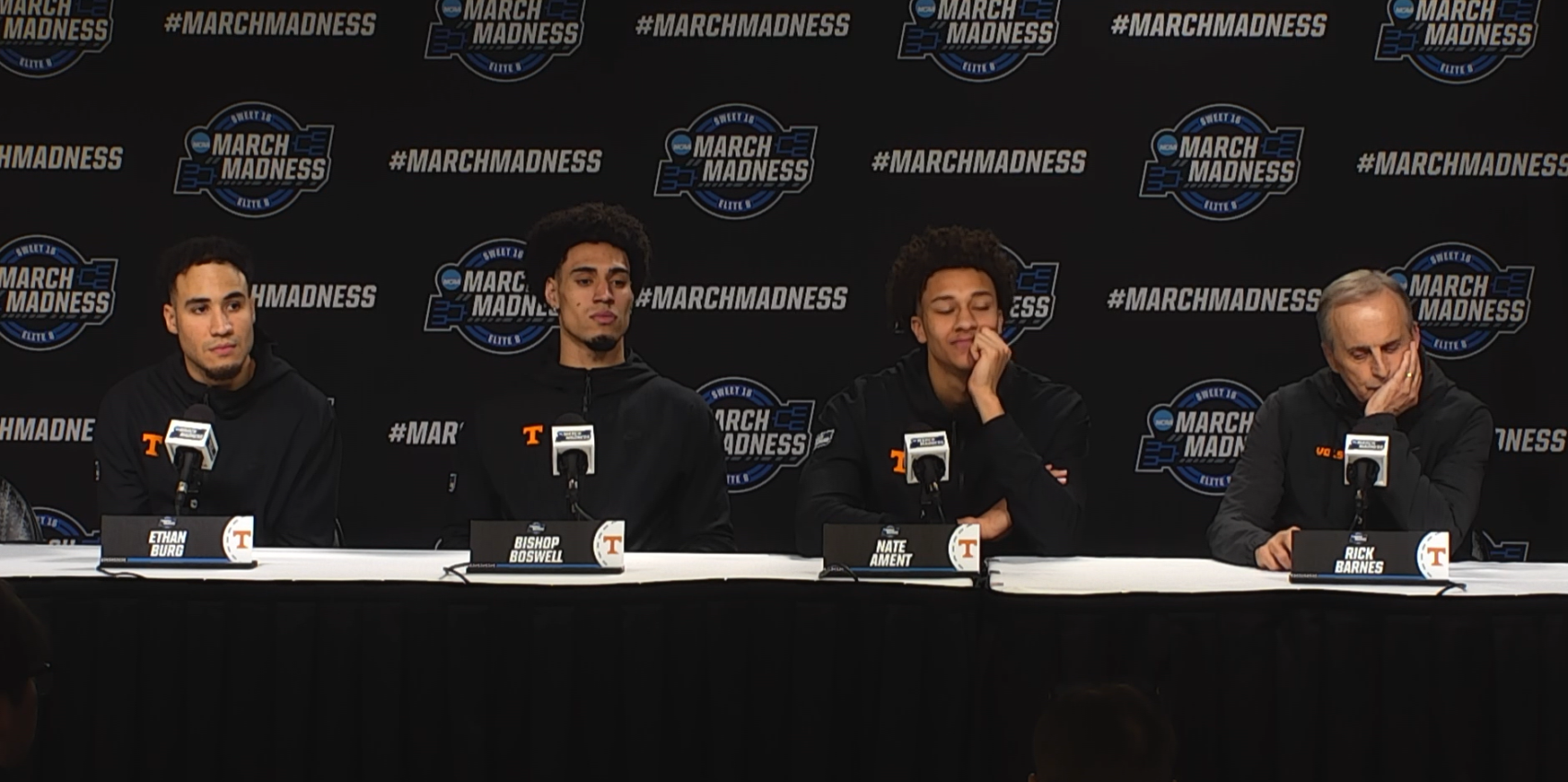
Rick Barnes, Nate Ament, Bishop Boswell and Ethan Burg were all on the podium Saturday to preview the Elite Eight clash against Michigan.
Q. I have a question for Nate. When you suffered that injury in February against Alabama, I don’t think anyone would have faulted you if you decided to sit out for the rest of the season, given your lottery projection. Why was it important to come back and play in the NCAA Tournament?
NATE AMENT: I just had more to give. I wasn’t ready for my season to be over, but I also wanted to empty the tank out for the team so we would be in the best position to win.
Q. A lot was talked about what your front court did yesterday. Michigan has arguably the best front court in the country. How confident are you that that group that we saw dominate Iowa State yesterday can hold their own and then some tomorrow in the match-up?
BISHOP BOSWELL: I’m definitely confident in them. I’ve seen them all season hold their own, absolutely. Obviously, Michigan has a great group of guys over there. So do we. The coaches did a great job in the off-season of bringing in a bunch of bigs we can rotate in. I think we’ll about good.
ETHAN BURG: Like Bishop said, we’ve got a lot of depth. We’ve got really talented bigs, four bigs. And we’re going to do our job to try to feed them the ball, try to let them go to work. I know how talented they are, how capable they are, and I’m confident in them.
Q. My question, how do you think the team can improve in terms of limiting turnovers going into tomorrow’s a game for any of you guys?
NATE AMENT: I think just —
RICK BARNES: Tell me, I’d like to learn myself.
NATE AMENT: Just knowing that’s what it takes to win. Got to value the possession and sometimes even a contested tough shot is better than a turnover. And just getting to our spots and into our positions and trusting each other to make shots. If not, we’ll get the offensive rebound.
Q. Nate, just curious during the recruiting process, what was it that drew you to Tennessee and Coach Barnes in particular?
NATE AMENT: I don’t want to give him too much love because he’s right next to me, and I won’t hear the end of it if I do. But I mean, it was just I knew that coming into it, I needed to kind of increase my motor and become a more of an effort player. Learned so much that way on the defensive end.
Coming here, I’ve grown so much offensively and defensively. I think I’m a completely different player than when I first got here.
Also, kind of the family aspect of the team and the team motto: It’s not about me. I knew that coming here we’d play for something bigger than any accolades I could win myself. So I just wanted to be part of a family and do something special that’s never been done and play for these guys and play for the university.
Q. For all three, Jaylen had a big game last night, was pretty fired up in a few moments. Have you seen the progression of his game? What does it mean when he plays like that and has the intensity he does.
ETHAN BURG: I feel like we all know what Jaylen is capable of. He’s very talented. Feel like Coach has been pushing him really hard. And that’s what I expect from him personally. We are at the biggest stage now. It’s win or go home. We need everybody to play to the best of their abilities in order for us to achieve our goals. So feel like Jaylen really stepped up and count on him to do it again.
BISHOP BOSWELL: He was such a presence, playing with that type of energy. The way he was vocal in the huddles brings another piece to our team if we want to go as far as we want to go.
Q. Nate, can you talk about Yaxel and how good you see he is as a player and the challenge of going against him? And then maybe, Bishop, how good is their offense? Is it among one of the best you’ve seen in the season based off what they’ve done so far?
NATE AMENT: Yaxel is a great player. Candidate for national player of the year. He’s deserved all of it. We’ve got our work cut out for us with him. It’s going to take a team effort to try to stop him.
To talk about Michigan, they’re a great team, really well coached, very disciplined. And, yeah, I mean, we’ve got to be locked in, especially on the defensive side if we want to have an opportunity to win the game.
BISHOP BOSWELL: Super dangerous offensively. I think they have a bunch of different pieces and guys that can come in off the bench and contribute, really shoot the ball. They’re a super dangerous in transition, especially Yaxel, just with his frame kind of getting downhill.
We’ve got to be locked into transition defense and build walls, guarding as a unit.
Q. For the players, there was a video on social media posted by the Vol Hoops account. You guys were saying the Lord’s Prayer after the game. I know Coach Barnes is a man of faith. How has that rubbed off on your guys over your time at Tennessee so far? Seeing something like that on social media, the comments kind of made an impact on folks around the country. Your thoughts on that going forward.
NATE AMENT: Specifically for me, it’s one of the reasons I chose Tennessee because of Coach Barnes and his faith. It trickles throughout the whole coaching staff.
I think as a team, you’re trying to glorify something bigger than yourself. And, ultimately, something that is Jesus Christ and is God can only lead to good things. When you’re playing for something other than your own glory and the glory of others, the glory of your teammates, the glory of Christ, only good things can happen from there if you’re being selfless and trying to take care of each other.
To see how it affects our locker room and how we’ve grown as a team because of it means so much. I’m truly grateful for it.
BISHOP BOSWELL: Another reason why I came here, you could be unafraid to kind of show your faith and we do that before and after every game. It’s just something that I personally value and a lot of the guys value in just being able to kind of share that with these guys. Whether you believe in Jesus Christ or you don’t, it’s a safe space for everybody to have conversations. It’s huge.
We have power talks where we can hear about the Lord and things of that nature and are able to tie it into basketball. It’s just his will be done. He’s the reason we’re in the Elite Eight and hopefully can get further.
ETHAN BURG: I’m Jewish so — I’m joking.
I enjoy taking part in it. It’s a beautiful tradition. I feel like it brings us together, just seeing the camaraderie we have the locker room. I think it’s beautiful. I enjoy being a part of that.
NATE AMENT: If I can add real fast, especially doing it before the game and after the game, just to know that good performance, bad performance, win or loss, Jesus is always there for you. Your worth isn’t in how you play as a basketball player, but it’s what Christ has done for you. You’re a child of his.
If we all understand that, kind of allows us to play with more confidence and play for something that isn’t a win or a loss, but to play so we can glorify him.
Q. Nate, I’ll start with you. This might be a part of what you’re talking about, a part of your answer. With some of the inconsistencies earlier in the year, why have you guys played your best basketball right now? Sometimes it can be a moment. Sometimes it can be natural. Why do you think you’re playing your best basketball right now?
NATE AMENT: That’s a great question. I think we just stuck with it throughout the whole year. No matter what it was, no matter what the problems were, we were going to try to find an answer for it. I think we’ve started to find some of those answers.
Again, we still have some questions we need to be answered. This team is just so resilient in the way that we come to work every day and try to get better. That’s kind of Coach Barnes’ message to us every day is how can we get better every day. Attacking that every day will ultimately lead to us getting better down the road. That’s what we’ve done so far.
Q. Bishop, if you could talk about Elliot Cadeau and what he brings to the table.
BISHOP BOSWELL: I played him in high school. I haven’t played him in college. Super talented guard. He’s super quick, but the best thing about his game is the way he’s able to get his teammates involved and run the show. He’s able to play off ball screens, get it to the bigs, get guys in position. He’s talented in that aspect.
Q. Tennessee has never been to a Final Four. Just wondering from your standpoint what it would mean to kind of break that and is that something that gives you any extra motivation?
ETHAN BURG: For me, it’s try to bring pride to the university and to the people in Knoxville. Obviously, we’ve got a huge fan base behind us that supports us every game, showing us live. For me, it’s first of all to go down in history. I want this team to make something special. I love this group of guys. I enjoy every moment with them.
It’s the reason we go out and play hard. We love playing with each other. It’s fun. It’s a blessing for me to be here at this stage. So just really bring pride to the city, to the university, like I said before, and I enjoy this. To me, it’s a blessing being here.
BISHOP BOSWELL: For me, it’s definitely an added motivation. I’m hungry for it. Last year, I was here and we were able to get to the Elite Eight thanks to the senior guys. We weren’t able to get it done. To see their faces, it hurt absolutely last year, watching the ceremony and everything of that nature and just seeing we weren’t able to get to that point.
So that’s what we worked so hard for all season. And through the ups and downs of it all, we knew we were able to get back to this point. We knew we were talented. I’m definitely hungry for it. So a little extra motivation.
NATE AMENT: It’s just something I’ve prayed for, something I really want. Like Ethan said, do it for the people of Knoxville, do it for the university, but also do it for the people who have been with me throughout the season. My teammates, my coaches, and something that I really want and I think we’ve all been hungry for it the whole season.
Q. To you, Coach, when you hear your student-athletes talk about their faith — and just kind of a two-parter — why you are comfortable sharing your faith and unapologetic about that and what it means to have student-athletes that want to have that in their atmosphere and their environment.
THE MODERATOR: Coach, his question was for you.
RICK BARNES: Say it again?
Q. Sure. Coach, what it means to you, your faith, and why you don’t hide your faith. And then, secondly, what it means to have players that embrace that.
RICK BARNES: Obviously, it is the most important thing in my life. I’m at a stage in my life where that’s really the most important thing in my life.
I do want our players to understand it because if I could go back — I’ve learned a lot more through the rearview mirror than I have looking forward. I wish, at their age, I would have gone much deeper into a relationship with Jesus Christ. And that’s one of the reasons, when I came to Tennessee 11 years ago, we started what we call power talk.
We have a wonderful person in Chris Walker who is part of the Fellowship of Christian Athletes, and they mentioned the fact that we do a power talk. We have for 11 years right before we have our pregame meal. It’s a gospel message related to what we do and where we might be at that time.
Chris and Scott Jackson, those two guys do that. Our governor had a great quote a couple weeks ago. He said there’s very few things in life that matter. We should be about them. I really took that to heart because to me, the most important thing is to love God with all my heart, soul, and mind. That’s where I am right now in my life and it’s the most important thing.
I’m proud of these guys because as they get older, they’re going to find out that it’s really the main thing, and I think that we all need to learn how to keep our thoughts on the main thing.
Q. Who influenced the way you coached defense and as stylistic changes have gone through college basketball through the course of your career, how much have you changed the way you coach it?
RICK BARNES: Not much. When I was blessed to become a head coach in, I think, ’87 at George Mason University, I’d had a great experience as an assistant coach. Every coach I grew up under, I learned something from. Gary Williams, Joe Harrington, Wimp Sanderson.
Being able to be an assistant coach in the Big Ten under Gary Williams, I watched Gene Keady and a bunch of guys work. When I was in the SEC with Coach, you know, I always listened to them say who they thought were really good coaches.
So the first NCAA Tournament I went to, I saw what I thought was the very best defensive team I’d ever seen, Charlie Spoonhour at what is now Missouri State. So when I got the head coaching job, I called Hugh Durham and asked if I could spend time with him. Then I called Charlie Spoonhour and did the same thing. They both did the same thing, the same drills that I — I used to do a lot of them. I don’t do as much of them. Not as much as I used to because Gary and Wimp influenced me a little bit in playing more 5-on-5.
But it all came from Henry Iba. It came from him. The drills that we use were the drills that — if you heard Coach Knight show drills or Al LoBalbo, that’s where it came from.
I don’t think I’ve ever invented anything with this game, but I know that I’ve been a guy that has stolen a lot of stuff from a lot of coaches. And I’ve learned from so many coaches. And I had a year at Davis with Bob McKillop, who has been probably my greatest mentor in terms of coaching. Bob and I still talk often. I think he’s one of the greatest coaches to have ever coached this game.
Our defensive scheme is — we don’t press as much as we used to. I had a wonderful athletic director, and I’ve had hard time — we were talking about it this morning. We knew at some point teams might throw out a zone. I watched John Scheyer do it throughout the tournament here.
My first year as a head coach, Jack Kvancz — who gave me my first opportunity, I love him to death — he and I had a weekly meeting. And we had a zone, we had a 3-2 I’d taken from Gary Williams. He asked me why I didn’t play zone very much. I said, well, I don’t know. The real reason would be I don’t know if we can rebound out of it.
He put this question in front of me. He said if you had a ball with a chance to win a National Championship, would you rather the team be in a man or a zone? I said man. He said, you know, why not play zone? You know? But he goes back. I’ve just had a chance to learn from so many people.
My first day in the big leagues, the day that Lou Carnesecca retired — we’d always run a zone press. He was the only guy we couldn’t press — I called Coach and said can I talk to you about your press offense? We’re using things today from Dean Smith, from Bobby Knight, from Lou Carnesecca. We’re still using that stuff.
People ask me all the time if the game’s changed. It has, but in some ways it hasn’t.
Q. Kevin Durant was here Monday night, scored 40 points against the Bulls. If someone told you 20 years ago he’d still be playing at an elite level in the NBA, you’d still be coaching at an elite level, which would have surprised you more?
RICK BARNES: Me. Because I was never elite. I’m not elite. He’s elite. I knew the first time that I saw him. I mean, Kevin is one of the most humble people. But it’s his work ethic. Hardest working player we’ve ever coached. To this day, the hardest working player we’ve ever coached.
He still does it. I mean, he loves being in the gym. And actually, you talk about recruiting, the last meeting I had with Nate before he committed a week later, I’d actually took our game with Kansas, where Kevin put on, I think, arguably one of the greatest shows ever, and he turned his ankle.
And I sat there and I showed it to Nate, and I said, if you don’t want to do this, we don’t want you at Tennessee. This is what we need you to do. I said but right now, if you don’t want this, you need to tell me and I will get up and walk out, and I hope and pray you have a wonderful career.
He said, that’s what I want.
Kevin, just his work ethic and his humility. Again, I can say his hard work, but still, anybody who knows him knows he’s one of the greatest teammates you could ever have.
Q. Rick, you’ve gotten a lot of criticism over the years for your results in March. I’m wondering if there’s any kind of satisfaction, given that for the third year in a row, you are one of the last eight teams standing?
RICK BARNES: You mean not doing well in the tournament?
Well, I’ve said before, I like to win every game. But our first two teams at Providence, we were picked to finish last in the Big East. Getting to the tournament was an incredible, incredible achievement. Did I make mistakes back then in coaching probably in this tournament? Certainly, I think I did. Probably putting way too much pressure on guys and maybe changing up what we did maybe too much.
Or, honestly, maybe and probably doing too much as opposed to doing less. But I will never take away from those guys because I know how hard they worked. I know that. Yeah, I mean, I know we lost some heartbreaking games. I can tell you that. We did.
I lost a game to Ohio State. I’ll never forget it. The last game on the second night, like at 9:00 at night. They had like a 40-foot shot on us. But I’m proud of all those teams. I really am.
Do I wish we could have won National Championships and all that? All I can tell you is we just stay in the arena. We’ll keep fighting as long as we can. Again, I’m proud of every team we’ve ever had in this tournament.
Q. Rick, how much does that Michigan loss four years ago in the tournament still hurt? And did that do anything to maybe spur you on into maybe changing some of the things you might have done in the tournament that now you’ve had — led to a lot more success?
RICK BARNES: Every team has its own personality. You start getting in a groove with them a little bit as the season goes on. We went through a time this year where we — I’ve said it before. We should have won five more games with this team, maybe more.
We turned the ball over at the wrong time, wrong place, with just things that somewhat were baffling at times. Because I think we’ve got really good players and guys I know how hard they work. I know how much they care.
We’ve tried to obviously continue to teach them the value of the basketball. But the one thing is we went through a month and a half where we didn’t know what we were going to get from 6 down to 12 or 13. We were just searching.
I thought one of the biggest things that we did that probably turned us around, we decided because of the inconsistencies and as the season goes on, we’ll start tapering our practices a little bit. We have a scout team, mostly with walk-ons. We started using guys that weren’t playing on the scout team.
And it ended up, we said this is helping them help us, and they were having to learn the other team’s sets and all those type things.
Ethan was on it for probably two weeks and never even did anything with the guys that were playing. But looking back, I know it helped him. I know it helped Amari Evans and Amaree Abram. It helped Troy. It helped all of them.
What pleased me about that, they didn’t take it as they were being put down or quit on them. It wasn’t that, which was a sign of their maturity. We had some guys — we would go through a two-day prep and it was all scout team and we put them in the game. They realized we meant what we said. If they practiced hard and were locked in, we’d play them, whether they got the reps they needed with us.
I think it was a big turning point with the group. I don’t know if I’d have told you at the time. But looking back, I think it’s something we got a lot more out of than we probably thought at the time.
Q. You talked the last couple days about how much you enjoy this and how blessed you feel to be back in this position. What drives you to get over this Elite Eight hump? Is it the competitive part personally? Is it for the guys who are sitting next to you just a moment ago to have them experience getting back to a Final Four? Is it for Tennessee? What is it that drives you the most to get the win tomorrow and get there.
RICK BARNES: Well, again, I mean, if you do this, you want to win. You do. I just want us to be the best we can be. I want us to be the best version that we can. If we’re good enough, we’re good enough. I have great respect for every opponent we play.
I don’t care who it is. I tell people in all of the time I’ve been in this, I haven’t coached against bad coaches. Everybody’s got their teams prepared. I know that these guys have worked hard. I know Michigan’s worked hard.
I mean, Iowa State, those guys got at it. But right now, we’ve got 40 minutes left in front of us, and it’s got to be the hardest 40 minutes. What we did yesterday has to be better tomorrow. Each player has got to do it.
It’s just every day, you get up — and Nate alluded to it — we’ve got one philosophy: Let’s get a little bit better today. Let’s just be better today than we were yesterday. And if we can build on that each day, we’re good enough to get to our goals, we’ll get there.
This group has, through all the ups and downs — I’ll tell you a great story with Ethan. He was really struggling, and I actually asked him one day, I said, are you about ready to quit? Because he was down, about as low as you could be.
He said to me, Coach, I will never, ever quit on these guys. He said, this is the first real team I’ve ever been a part of. He says if I never play another minute, I will never quit on these guys. I promise you. He said I love them. There’s a brotherhood with us. I would never quit on them.
And he hasn’t. The last couple games, we wouldn’t be here if it wasn’t for him. He has maturity, and he went through a tough time.
You’ve got to realize, his family has been in and out of bunkers in Tel Aviv for months now. It’s been tough on him, but he’s handled it really, really well.
That was one of the greatest things that any player’s ever said to me. He said, I would never quit on these guys. And he wasn’t playing. He just kept grinding and good things happen to people that do that.
Q. Rick, you’ve seen a lot of teams throughout your tenure, and I’m sure you’ll get a better sense tomorrow. On film, what sort of level or echelon does this Michigan team appear to be on? Like what stands out to you?
RICK BARNES: Any team that — they’re beating people by 40, 50 points. That doesn’t happen, you’d think, in today’s world.
Every spot, they got guys that can — their depth, everything about them. They’re well coached. So sound fundamentally and explosive.
Their size defensively is a factor. They just impact the game on both ends of the court, and they seem like they have a team that — doesn’t seem like. When you win the games they’ve won, obviously there’s a buy-in there with each one of them on their team. I have the utmost respect for them.
Q. Coach, you mentioned last week that Coach Gainey was ready to coach any school in the country. Obviously, his name’s come up with NC State opening. What have you talked to him about that process and why do you feel like he’s prepared for that?
RICK BARNES: I hope he gets the job. I don’t think there’s anybody in the country that loves NC State more than Justin Gainey. He’s a North Carolina native. He went to NC State, played four years there, started four years. Helped win an ACC tournament.
He has just incredible pride in his university. A terrific basketball coach. I mean, if you come to our walk-throughs, like today or the other day, he scouted the last game. I don’t say a whole lot because those guys have it.
But Justin has an incredible feel for the game, really understands players. He works at it. Terrific recruiter. Understands the NIL era today. If NC State knew what I knew, they would be begging him to be their next head coach. Because he’s ready not just for NC State, he’s ready to be the head coach of the University of Tennessee or any school in the country. He’s that good.
I’ve been with him through a lot of these games, and he recruited Nate. He was the lead recruiter on him. And just phenomenal job.
With all that said, one of the finest people I’ve ever been around and beautiful family.
Q. Rick, you’ve gotten credit for adjusting to today’s world in college athletics and everything that comes with that. Why have you still been able to connect with young players? Is that recruiting the right kind of players that are willing to be coached hard? Is it something else? Why have you still connected with young players?
RICK BARNES: I’ve always thought the biggest reason back in the day when players did transfer, I often thought it was because the recruiting process. Sometimes things were promised that weren’t kept. I certainly have always believed the most important thing in recruiting is transparency right from the beginning in terms of everything.
Like I’ve often said, if you really want to know what we’re about, you need to come to campus. You need to spend time with our players. You need to ask them. I’ve found through the years that players really are honest with each other.
Watch how we do practice. Our practices are open to anybody. We have parents that come to watch practice. And I’m not going to change. You’re there, you see I’m not changing. I don’t care who’s there, parents. We’re going to be who we are every single day.
I think as long as you’re truthful with people and when you have hard practices — and our practices are demanding. But I have, again, a great coaching staff. Those guys know that if I’ve had a day where I’ve gotten on a lot of guys, we’re always in our locker room with them after practice, having dinner with them, staying with them.
We have a situation where my staff, they get this. We know that we are blessed to have a chance to be with guys like this. And our job is to help these guys reach their ultimate goal. They all want to be pros. They all want to be.
We don’t want to be the ones that look back and say we didn’t do our part. We want to look back and say we did everything we could for them and the time with us was the greatest time they ever had in their life.
It goes back to, I think, being direct. I think it goes back to being brutally honest. And some you’re going to get and some — like the night with Nate, I said I’m gonna tell you the truth. This is what we need. And the last thing I said to him, if you choose to do this, it’s going to be the hardest thing in your life, and there’s going to be days you’re not going to like me very much. But when it’s all said and done, you’ll understand all of it.
I think it’s being truthful with people. If you do that, any situation that comes up, you can work through it.
Q. Coach, you faced Dusty May on the NCAA tournament stage before. He was at FAU where he had great success. Now is doing the same at Michigan. Having success at two different schools, what does it say about his ability to build a program?
RICK BARNES: He’s a terrific basketball coach. The times I’ve been with him — I love him as a human being. I mean, again, he knows what he’s doing, obviously. There are so many coaches — like I mentioned Bob McKillop. If Bob would have chosen to — I think he could have been on the big stage if he wanted to.
There are so many guys that are talked about that could have been great basketball coaches. You get that chance and obviously, Dusty did a great job. Then he gets one of the great jobs in the country. He believes in what he believes in.
You watch his teams play, there’s a definite trait there that you understand what is important to him. It’s a winning formula. He stays with it. Certainly, like all of us have to do today, we have to adapt to what’s going on in the NIL. But, again, just great respect for him.
Q. Coach, you talked earlier about every team is unique that you’ve had. What makes this team’s identity different than the previous two that got to this point? And why may that identity be the difference in getting over the hump this time?
RICK BARNES: The previous two, they kind of grew up with us, Zakai and Jahmai, and we plugged in with Dalton Knecht and Chaz.
This group, we started with 11 new players, but we felt like we’d improved in some areas. A year ago, we had absolutely no presence at all in the post. J.P. had been hurt a little bit. Felix was coming in for the first time really.
But this group started out — and we knew at the end of last year, there are two top targets in the portal, Ja’Kobi and Jaylen. We miss Cade. We still do. That was another rim protector we had.
It’s just when we started last spring, Clarence wasn’t with us. He didn’t get here until late. Ethan came in later than him, which it’s always hard to catch up. But we thought when we took Ethan that his maturity — 23-year-old spending time in the Israeli Army — maturity would catch it up.
We realized with him too, he was learning a whole new game. I mean, the game he played was totally different than what we do.
Then you go back, DeWayne Brown — every year in recruiting, somebody is going to surprise you, somebody is going to disappoint you. DeWayne has no doubt been the biggest surprise this year, which is great.
Cade fought that shoulder thing for as long as he could and finally couldn’t. So I think the fact that Felix and DeWayne went at each other every day — and I look back right now. The guys that never missed any reps all summer were Nate — nobody — Ja’Kobi Gillespie, you talk about an iron man, I don’t think he’s ever missed a practice. He went all reps all summer along with Felix and DeWayne.
But they just stayed connected. They’ve pushed each other. Even when we were talking about putting guys on the scout team, we didn’t want those guys in any way, shape, or form thinking that we had quit on them. At that time, we were so inconsistent, we were searching for whatever we could find.
We wanted them to know we were trying to do it to get them to understand if they can get better, we can get better. The guys that haven’t been on the scout team, I think, made those guys realize how much they were helping them get better, as opposed to going against scout teams as much as we were doing it once we got into the season.
But I think what Ethan told me speaks volumes about it’s the first real team he’s been a part of. And I would say with 11 new guys, in today’s environment, that’s important. Can you get guys to come in with so much of the outside things that are going on and buy into wanting to be a really special basketball team.
I’ve got to give them credit because I think that locker room’s theirs. We are in the lounge a lot with it right there. It’s fun setting outside after dinner, hearing them cut up and have a good time before G goes in to tell them film room, just hearing them laugh.
It’s been a group like that. And I tell you what. When we’ve lost, I can tell it hit them. It hurt them. I’ve tried as much as I can to let them enjoy the wins more than I probably do. It’s just, again, God’s blessed us with a group of guys that are very unselfish is what it gets down to.
Q. Rick, it’s become popular for guys in their 40s, like Dusty, to say they’re not going to do this as long as, you know, you and Izzo and Calipari and guys of your generation.
Do you believe them? And what would you say to them about being your age and still doing this?
RICK BARNES: Well, I think if you love to coach basketball, I think it’s okay to be — and I’m not demeaning this. A seventh and eighth grade basketball coach, ninth grade coach. If you love being in the gym coaching basketball, do it as long as you can.
I really believe that when Tom and I — Tom and I met back in 1985 at Columbus, Ohio, watching Eli Brewster play in a gym in Columbus, Ohio. Cal and I worked the Pitt camp together in 1977 at Pittsburgh. Sean Miller was my starting point guard on the team at 8 years old. We won the championship. That was his first championship and my first championship.
You know, the game has certainly changed, and I will say this. We got into it because we love coaching basketball. And I know that. I know talking to those guys, even today. They really still love going in the gym. They love the challenge of putting together a group of guys that can play beautiful basketball. And each one of us, each team’s different, but we love doing it.
I just feel like this is where God’s put me at this time, and I’m blessed. But I do, I love coaching basketball, and I do know that God will make it perfectly clear when my time’s up. I’ve said before this week that I’m in a wonderful situation at the University of Tennessee.
I don’t know if I would say that if I were those guys because I will say this. It’s easier today than it was back then because today, it’s easy. You can recruit a guy now for a week and get him. You know what I mean? Hey, what’s the number?
But in some ways, it’s easier. I’m being brutally honest. It really is. Because it’s different there. The stakes are higher. When I got in it, I think there were maybe 150 Division I teams. Now there’s 300. With what’s at stake now, everybody wants to win every time they go out.
Every team does. I know this. You don’t take any of it for granted because it can end quickly, and I’ve just been blessed. I thank the good Lord for the opportunity he’s given me all these years.






Discuss the Article